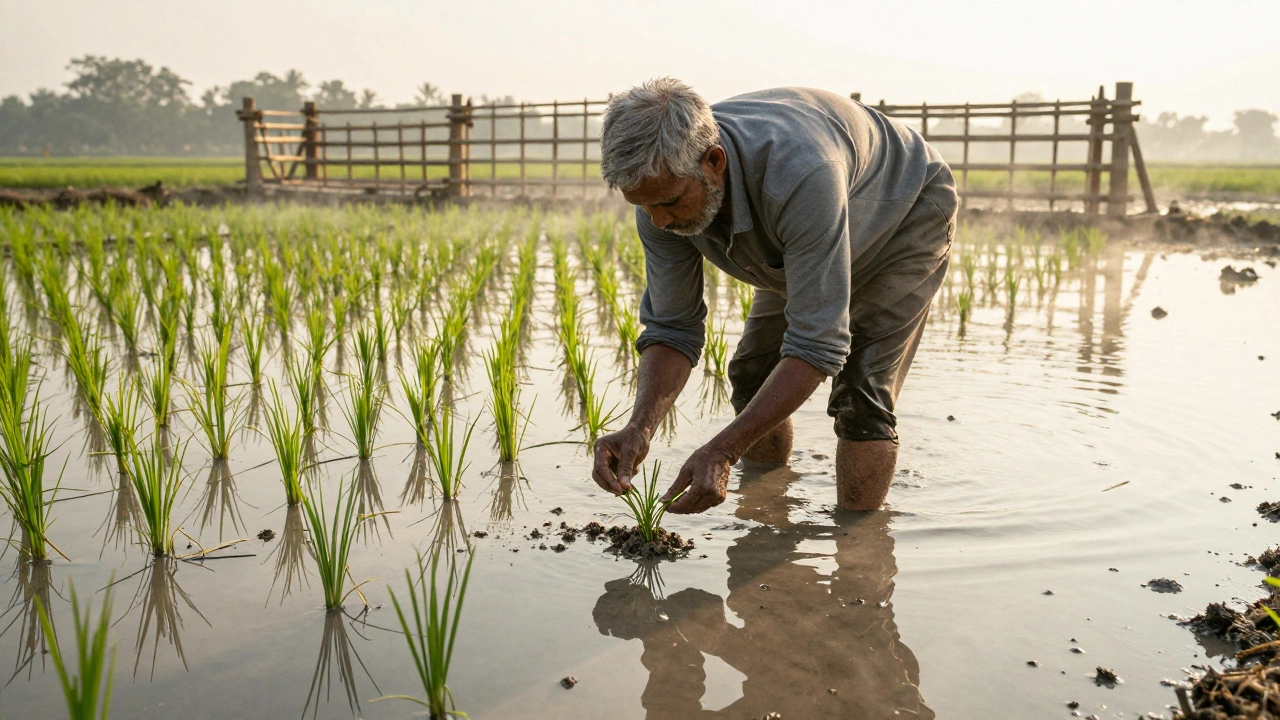
Rice feeds billions, but growing it requires perfect water control, warm temperatures, heavy soil, and relentless labor. Even small mistakes can wipe out an entire crop.
Rice Farming Challenges in India: What’s Holding Back Yields?
When you think of rice in India, you picture endless fields stretching under the sun—but behind that image are real, growing problems. Rice farming, the practice of growing paddy rice as a staple crop across India’s plains and deltas. Also known as paddy farming, it feeds over 65% of the population and supports nearly 40 million smallholder families. Yet, despite its importance, rice farming is under strain. Water scarcity, rising input costs, and unpredictable weather are making it harder than ever to grow enough rice to meet demand.
One of the biggest rice cultivation, the full cycle of planting, managing, and harvesting rice crops issues is water. Rice needs a lot of it—up to 5,000 liters per kilogram—but groundwater levels are dropping fast in Punjab, Haryana, and Uttar Pradesh. Farmers are drilling deeper wells, but that’s not a fix—it’s a race against depletion. At the same time, monsoons are arriving late or too strong, flooding fields one year and leaving them cracked the next. This instability makes planning impossible for small farmers who can’t afford insurance or storage.
Then there’s the cost. Fertilizers, pesticides, and diesel for pumps have doubled in price over the last five years. Many farmers still use outdated methods—flood irrigation, hand transplanting, and chemical-heavy inputs—because they don’t know better or can’t access training. Meanwhile, soil health is slipping. Continuous rice cropping without proper rest or organic matter has turned once-fertile land into compacted, nutrient-poor ground. And while new varieties promise higher yields, they often need more water or chemicals, creating a trap: grow more, spend more, risk more.
But it’s not all bad news. Across India, farmers are testing alternatives: direct-seeded rice that cuts water use by 30%, laser-leveling fields to reduce flooding, and integrating fish or ducks into paddies to control pests naturally. These aren’t fancy tech fixes—they’re smart, low-cost adjustments that work with nature, not against it. The real challenge isn’t just growing rice—it’s growing it sustainably, without burning out the land or the farmers who depend on it.
What follows is a collection of real, practical guides from farmers and experts who’ve faced these same problems. You’ll find solutions for soil recovery, water-saving techniques, and ways to cut costs without sacrificing yield. No theory. No fluff. Just what’s working on the ground—in India’s rice fields today.