Rice Farm Scale & Yield Calculator
Calculate the estimated scale and yield of a rice farm based on regional farming styles. This tool compares intensive smallholder models against mechanized industrial operations.
When you picture a rice farm, what comes to mind? Endless green paddies stretching to the horizon? Or maybe a small, muddy plot worked by hand with a simple wooden plow? The truth is, there isn't just one type of Rice Farm, which makes answering "how many acres" tricky. It depends entirely on where you are in the world and how the crop is grown. In the United States, farms are massive industrial operations. In parts of Asia, they might be smaller family plots. If you're trying to understand the scale of this global staple, you need to look at the data behind the dirt.
Before we get into the numbers, it's worth noting that agriculture is changing fast. Technology is shifting how we manage land, from drone monitoring to automated harvesters. While I'm focusing on rice today, the principles of land management apply everywhere. For those interested in other types of structured directories or niche resources-like perhaps a specialized listing for services in specific regions-you can find examples of how modern categorization works at this resource. But back to our crops: let's break down exactly how big a typical rice farm really is.
The Global Average vs. Regional Realities
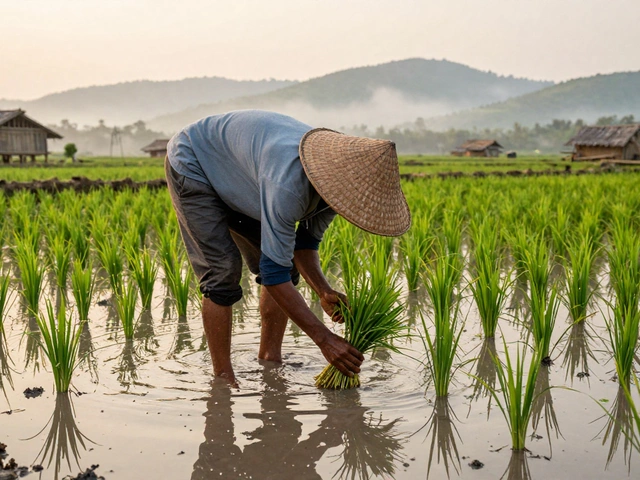
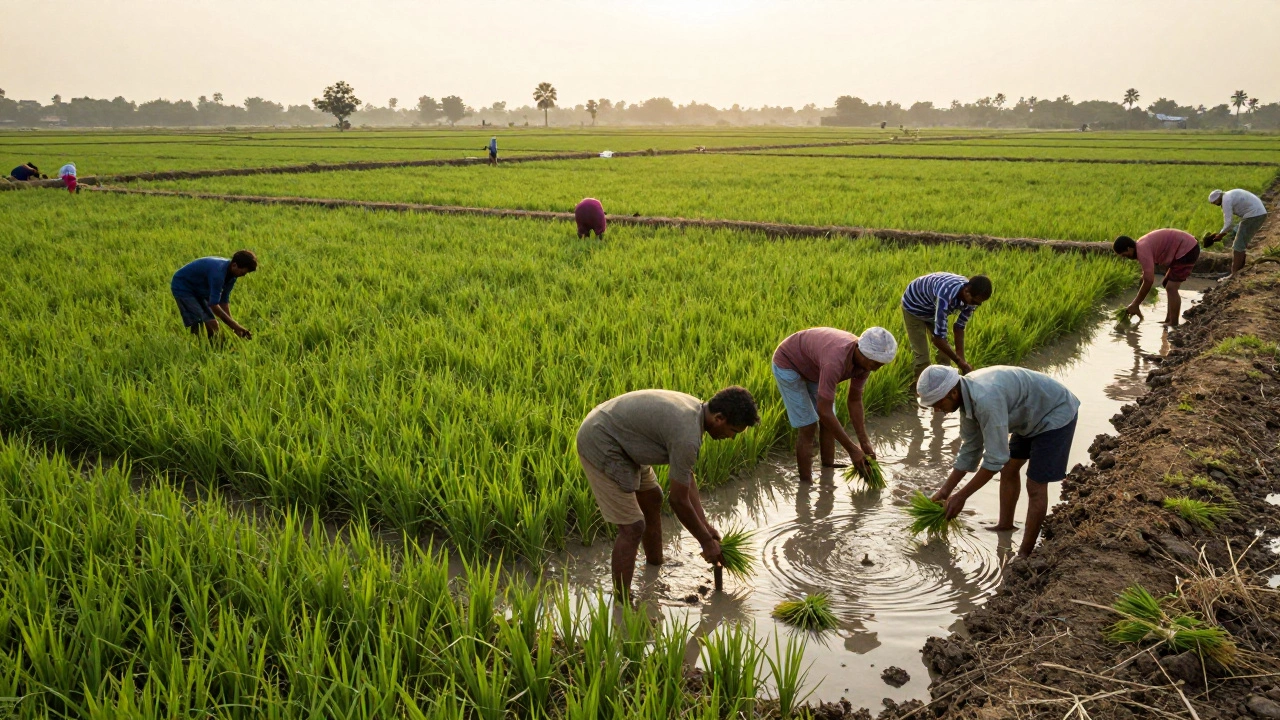
If you take all rice farms in the world and average them out, the number is surprisingly small. Globally, the average rice farm is often less than two acres. Why so tiny? Because the vast majority of rice production happens in Asia, specifically in countries like India, China, and Bangladesh. Here, land inheritance laws and population density mean farms are passed down through generations, getting smaller each time. A family might own just half an acre, working it intensively to feed their household and sell the surplus locally.
However, looking at the global average hides the real story. To understand the industry, you have to split it into two very different worlds: the intensive smallholder model and the mechanized large-scale model.
| Region | Average Farm Size (Acres) | Farming Style | Primary Labor Source |
|---|---|---|---|
| Southeast Asia (e.g., Vietnam, Thailand) | 1 - 5 acres | Smallholder / Family | Manual labor |
| South Asia (e.g., India, Bangladesh) | 0.5 - 2 acres | Subsistence / Smallholder | Family labor |
| United States (Arkansas, California) | 800 - 1,500+ acres | Mechanized / Industrial | Machinery |
| Europe (Italy, Spain) | 50 - 200 acres | Semi-mechanized | Mixed (Labor + Machines) |
The American Giant: Mechanized Scale
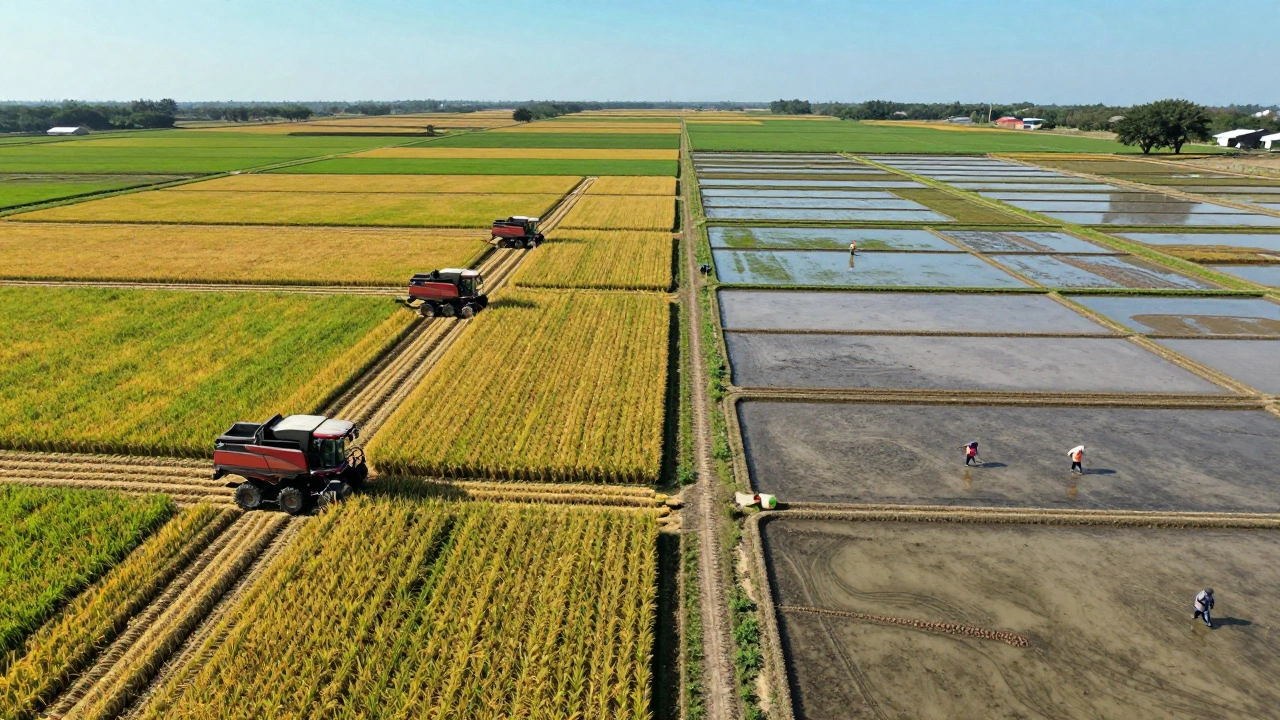
In the United States, rice farming looks nothing like the traditional images from Asia. Here, rice cultivation is an industrial powerhouse. The USDA reports that the average rice farm in states like Arkansas, Louisiana, Texas, and California ranges from 800 to over 1,500 acres. Some of these operations cover thousands of acres.
Why the difference? It comes down to technology and economics. American farmers use massive combines, tractors, and precision planting equipment. They don't walk the fields; they drive across them. This scale allows them to produce huge volumes of grain efficiently. The cost per bushel drops significantly when you spread overhead costs across a thousand acres instead of ten. These farms rely heavily on controlled irrigation systems and advanced soil management techniques to maintain yields year after year.
Asian Intensity: Small Land, High Output
Contrast that with Vietnam or Indonesia. There, a farmer might tend to three acres of wetland. You'd think this means low productivity, but that's not true. These small farms are incredibly productive per unit of land. Farmers here practice multiple cropping cycles, sometimes harvesting twice or even three times a year. They invest heavily in manual care, ensuring every plant gets attention. While they lack the giant machinery of the US, they make up for it with labor intensity and deep knowledge of local micro-climates.
This model supports millions of families. It’s not about maximizing profit per acre in dollar terms; it’s about food security and livelihood stability. The social structure around these small farms is tight-knit, often involving community water-sharing agreements that have existed for centuries.
Factors That Determine Farm Size
So, what decides whether a farm is 1 acre or 1,000? Several key factors come into play:
- Labor Availability: If cheap labor is available, smaller farms can thrive because they can afford intensive manual work. If labor is expensive or scarce, you need machines, which require more land to justify the investment.
- Land Cost and Ownership Laws: In countries with strict land redistribution policies or high population density, plots remain small. In places with open land markets, larger entities buy up acreage to create economies of scale.
- Irrigation Infrastructure: Rice needs water. Large-scale farms often build their own pumping stations and canal networks, requiring significant capital. Small farms usually depend on communal water sources or rainfall.
- Market Access: Farms near ports or major processing plants can handle larger volumes. Remote smallholders might only grow enough for local markets due to transport costs.
Economic Implications of Scale
The size of the farm dictates its economic strategy. Large US farms operate on thin margins but high volume. They hedge against price fluctuations using futures contracts and focus on reducing input costs like fertilizer and fuel. Their success depends on efficiency metrics: gallons of water per pound of rice, bushels per acre, etc.
Small Asian farms, meanwhile, focus on yield maximization and risk diversification. They might grow vegetables between rice cycles or raise fish in the paddies (a system called rice-fish culture) to add income streams. Their resilience comes from flexibility, not scale. When prices drop, they can switch crops faster than a large monoculture operation.

Future Trends in Rice Farming Size
As climate change impacts water availability and urbanization eats up arable land, we’re seeing shifts. In some developing nations, younger generations are leaving farming, leading to consolidation as older farmers sell to neighbors. This could gradually increase average farm sizes in Asia over the next few decades.
Conversely, in the West, environmental regulations and water scarcity might force some large operations to shrink or adapt. Precision agriculture technologies allow even medium-sized farms to compete with giants by optimizing every drop of water and gram of nutrient. The future isn't just about bigger; it's about smarter.
Key Takeaways
- There is no single "average" rice farm size globally.
- In Asia, farms are typically under 5 acres, relying on manual labor.
- In the US, farms are massive, often exceeding 800 acres, relying on heavy machinery.
- Scale determines economic strategy: volume vs. intensity.
- Technology is blurring the lines, allowing smaller farms to be more efficient.
What is the smallest viable rice farm?
The smallest viable rice farm can be as little as 0.25 acres if it's used for subsistence or experimental purposes. However, for commercial viability in most markets, a minimum of 1-2 acres is usually needed to generate meaningful income after covering input costs.
Do larger rice farms always produce more rice?
Not necessarily. While larger farms produce more total volume, smaller farms often have higher yields per acre due to intensive management. A 5-acre Asian farm might produce more rice per square foot than a 1,000-acre US farm, even though the US farm produces far more in total.
How does water access affect rice farm size?
Water is critical. Large farms need reliable, large-scale irrigation infrastructure, which limits where they can operate. Small farms can utilize rain-fed systems or shared community water channels, allowing them to exist in areas where large-scale irrigation isn't feasible.
Is it profitable to start a small rice farm?
Profitability depends on your market. Selling directly to consumers as specialty or organic rice can make small farms profitable. Competing in the bulk commodity market is difficult for small players due to the low margins achieved by large-scale producers.
What equipment is needed for a 10-acre rice farm?
A 10-acre farm would likely need a small tractor, a rotary tiller for preparing the mud, a seed drill or broadcast seeder, and possibly a small combine harvester or contract harvesting services. It sits in the middle ground between manual labor and full industrialization.