Discover which landscapes give rice the best chance to thrive. Explore proven facts on topography, water management, and land tips to boost your rice harvests.
Best Topography for Rice: Ideal Land Shapes and Slopes for Indian Farms
When it comes to growing rice, the shape of the land isn’t just background—it’s best topography for rice. Rice isn’t like wheat or maize that can grow on hillsides. It needs water, lots of it, and it needs to stay put. That’s why flat or gently sloping land, with good water retention and natural drainage, is what most successful rice farms in India rely on. This isn’t theory—it’s practice passed down through generations of farmers in Punjab, West Bengal, and Odisha, where rice fields look like giant, tiled mirrors after the rains.
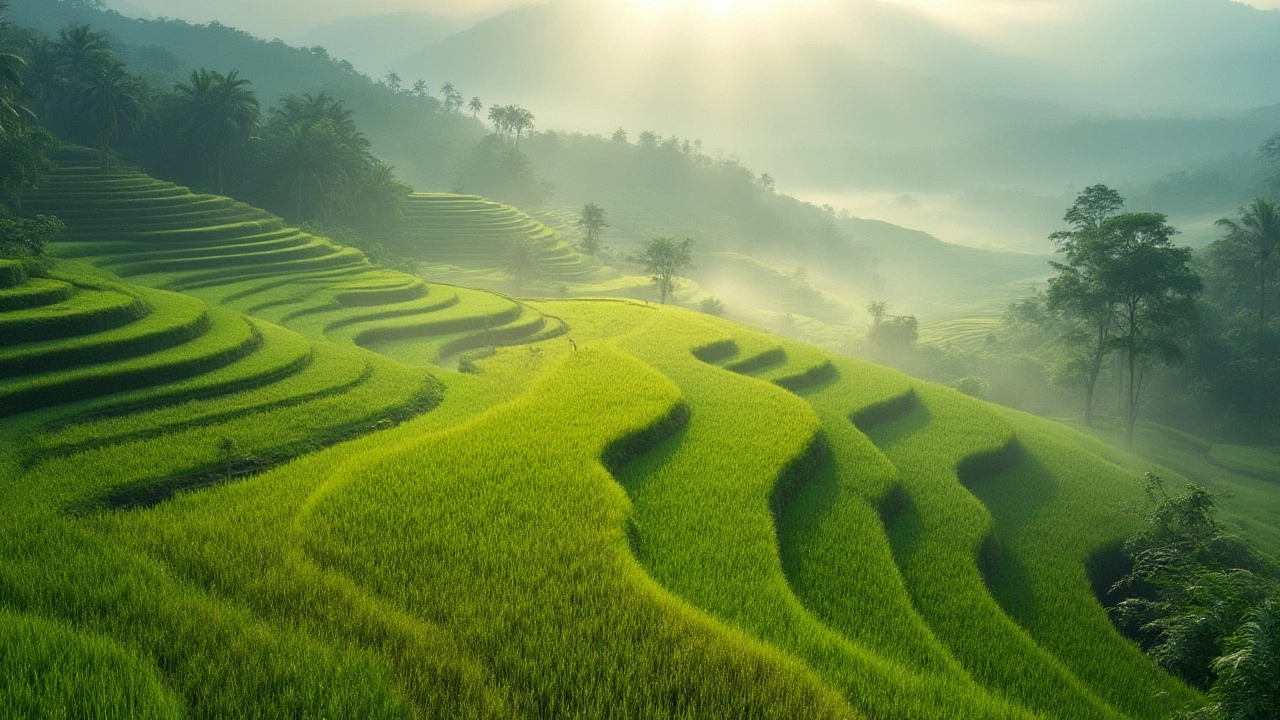
Topography matters because rice needs flooded conditions during its early growth, but too much slope means water runs off before the roots can drink it in. A slope of less than 2% is ideal. Anything over 5% and you’re fighting erosion, uneven flooding, and wasted water. In places like the Gangetic plains, where the land is naturally flat, farmers can flood entire fields with ease. In hilly regions like parts of Assam or Kerala, they build terraces—step-like fields carved into the hillside—to mimic that flatness. These terraces aren’t just for show; they’re engineering solutions to a physical problem.
Soil depth also ties into topography. Shallow soils on steep slopes don’t hold water or nutrients well. Rice roots need at least 15–20 centimeters of rich, clayey soil to anchor and feed. That’s why the best rice land isn’t just flat—it’s deep, heavy, and sticky enough to hold water like a bucket. In contrast, sandy or rocky terrain? Forget it. Even with irrigation, the water drains too fast, and the plant starves.
Water sources matter too. Flat land near rivers or canals gives farmers control. They can channel water in and out without pumps or expensive systems. In places where rainfall is heavy, like coastal Odisha, natural drainage from higher ground helps flush out salts and toxins. But if the land slopes the wrong way—toward a road or neighbor’s field—you’re not just losing water. You’re losing money.
And here’s something most guides miss: topography affects labor. Flat land means you can use small tractors or even mechanical transplanters. Sloped or uneven land? You’re back to hand planting and weeding. That’s why in India, where labor is expensive and hard to find, the best topography for rice isn’t just about yield—it’s about keeping farming affordable and sustainable.
You’ll find posts here that talk about soil amendments, drip systems, and balcony gardens—but none of those fix a bad slope. No fertilizer can replace good land. The articles below show real examples from Indian farms: how farmers in Bihar shape their fields, how terraces work in the Himalayan foothills, and why some land just can’t grow rice no matter how much you water it. These aren’t guesses. They’re lessons from the ground up.