Arsenic Reduction Calculator
Reduce Arsenic in Your Rice
Based on FDA and UK Food Standards Agency research, this calculator shows how much arsenic reduction you get from different preparation methods.
Estimated Arsenic Reduction
Your ResultsBased on FDA recommendations
Every time you rinse your rice before cooking, you’re probably thinking about cleanliness. But if you’ve heard that washing rice removes arsenic, you’re not alone. Millions of people do it out of habit-or because they’re worried about health risks. So does it actually work? The short answer: washing rice reduces arsenic, but not nearly as much as you might hope. And there are better ways to cut exposure.
Where does arsenic in rice come from?
Rice absorbs arsenic more than most crops because it’s grown in flooded fields. Arsenic is a natural element in soil, but human activity-like old pesticides, chicken manure fertilizers, and contaminated water-has raised levels in many farming regions. Rice plants pull it up from the ground like a sponge. Brown rice holds more arsenic than white rice because the outer bran layer, where arsenic sticks, isn’t removed.
Studies from the FDA and the UK Food Standards Agency show that rice from certain areas, like Arkansas, Louisiana, and Texas in the U.S., or parts of India and Bangladesh, can have arsenic levels up to 30% higher than rice from California or Egypt. Even organic rice isn’t safer-it’s still grown in the same soil.
What happens when you wash rice?
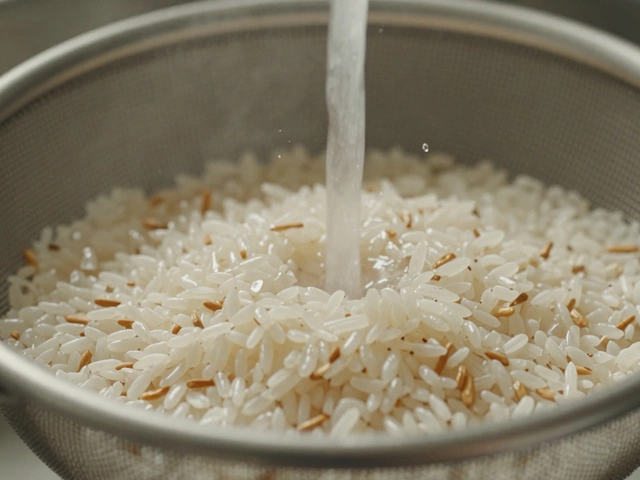
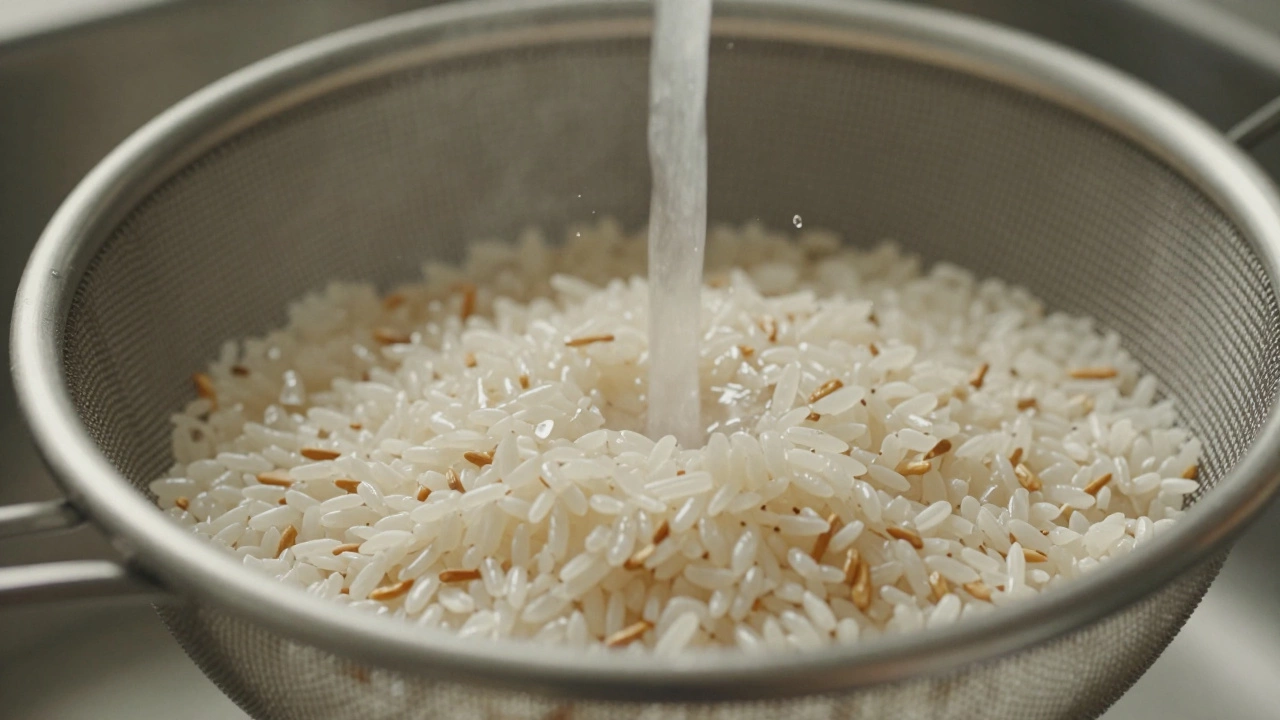
Washing rice before cooking removes some surface dust and debris. It also washes away a small amount of arsenic-about 10% to 25%, according to research published in Environmental Science & Technology. But arsenic doesn’t just sit on the surface. It’s absorbed into the grain’s structure. So rinsing once or twice won’t make a big difference.
One 2012 study from the University of Sheffield found that washing rice five times reduced inorganic arsenic by 22%. But that’s still leaving 78% behind. And you’re also washing away some nutrients: B vitamins, iron, and folate. If you’re rinsing rice just to remove arsenic, you’re trading one problem for another.
The best way to reduce arsenic in cooked rice
If you want real results, cooking method matters more than washing. The most effective technique is to cook rice like pasta: use a lot of water and drain it.
Here’s how:
- Use a 6:1 water-to-rice ratio. That’s six cups of water for every one cup of rice.
- Bring it to a boil, then simmer until the rice is tender-usually 10 to 15 minutes.
- Drain the excess water through a fine mesh strainer.
- Rinse briefly with hot water if you like.
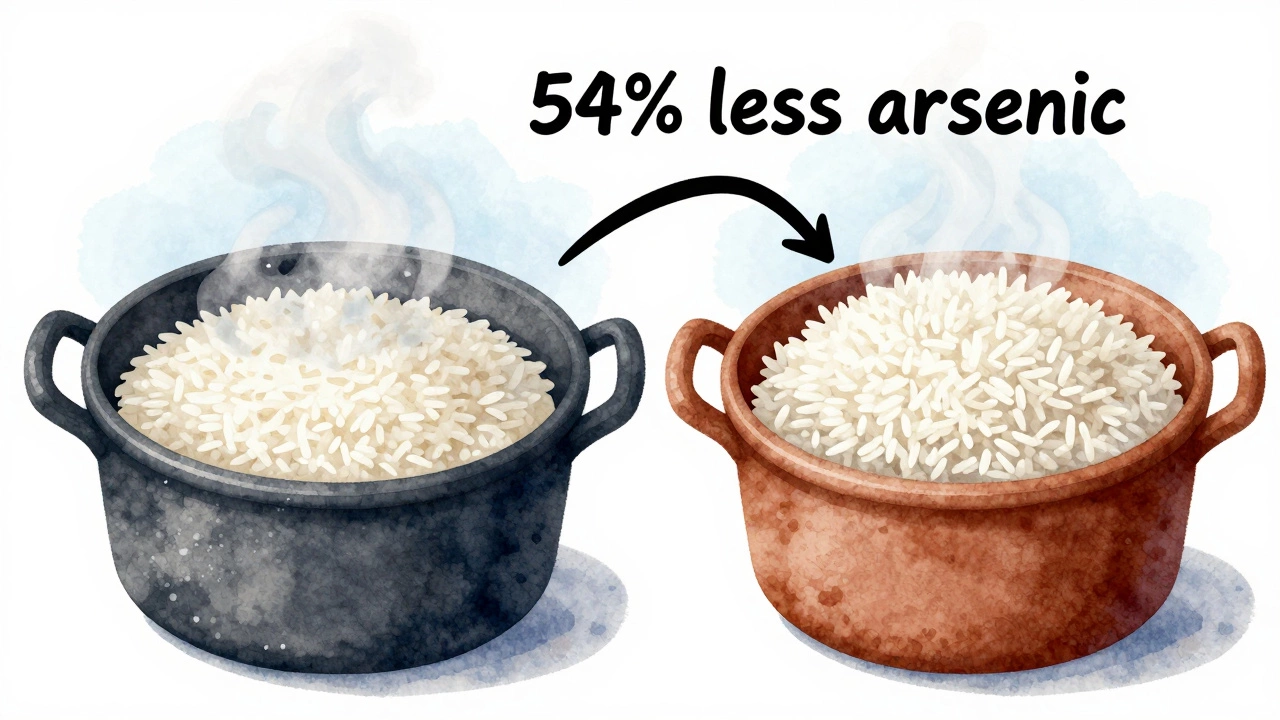
This method removes up to 54% of inorganic arsenic, according to the same Environmental Science & Technology study. It works because arsenic dissolves into the water, and you’re throwing that water away. It’s like boiling pasta and discarding the starchy water-you’re not losing flavor, just the unwanted chemical.
Some people use a rice cooker with a “drain” setting. These are designed to automatically drain excess water at the end of cooking. If you have one, use it. It’s the easiest way to get the same result without extra work.
What about soaking rice overnight?
Soaking rice for 12 hours or more can reduce arsenic by 30% to 40%. The longer soak allows water to penetrate the grain and leach out some of the arsenic. But here’s the catch: you have to discard the soaking water and rinse the rice before cooking. Don’t reuse the water-it’s now full of arsenic.
Soaking also changes the texture. It makes rice softer and quicker to cook. If you’re making risotto or sushi, this might not work. But for everyday brown rice or basmati, it’s a solid option. Just keep it in the fridge to prevent bacteria.
Which rice has the least arsenic?
Not all rice is created equal. Some varieties naturally absorb less arsenic.
- Basmati rice (from India, Pakistan, or California) has among the lowest levels-about half the arsenic of regular white rice.
- Jasmine rice (from Thailand) is also relatively low.
- White rice generally has less arsenic than brown rice because the bran is removed.
- Wild rice (technically a grass) has almost no arsenic. It’s pricier, but a great alternative.
- Avoid rice from Arkansas, Louisiana, or Texas unless you’re using the high-water cooking method.
Look for rice labeled “low arsenic” or certified by third-party groups like the Whole Foods Market or the Soil Association. Some brands now test and label their batches.

Who should be most concerned?
Adults eating rice a few times a week aren’t at high risk. But certain groups need to be more careful:
- Babies and toddlers: Rice cereal is a common first food, but it can contain high arsenic levels. The American Academy of Pediatrics recommends limiting rice cereal to once a week and switching to oat or barley cereal.
- Pregnant women: High arsenic exposure during pregnancy may affect fetal development. Swap rice for other grains like quinoa, barley, or bulgur.
- People who eat rice daily: If you’re vegan, gluten-free, or from a culture where rice is eaten at every meal, you’re likely consuming more arsenic than recommended.
The European Food Safety Authority says adults should limit inorganic arsenic intake to 0.3 micrograms per kilogram of body weight per week. For a 70kg person, that’s about 21 micrograms per week. One cup of cooked rice can contain 3 to 5 micrograms. So if you’re eating two cups of rice daily, you’re over the limit.
What about rice products?
Rice isn’t just in your bowl. It’s in rice milk, rice syrup, rice crackers, and gluten-free pasta. These products can be just as high in arsenic, if not higher.
Rice milk, for example, has been found to contain up to 10 times more arsenic than cow’s milk. The UK’s Food Standards Agency advises against giving rice milk to children under 5. If you’re using rice milk as a dairy alternative, rotate it with oat, almond, or soy milk.
Rice syrup is often used in organic snacks and energy bars. It’s a concentrated source of arsenic. Check labels-if it’s listed as the first ingredient, avoid it.
Final tips: How to eat rice safely
You don’t need to quit rice. But you can eat it smarter:
- Always cook rice with plenty of water and drain it.
- Choose basmati or jasmine rice when possible.
- Swap rice for other grains once or twice a week: quinoa, barley, farro, or buckwheat.
- Don’t rely on rinsing alone-it helps a little, but it’s not enough.
- For babies, avoid rice cereal as a daily staple.
- Read labels on rice-based snacks and drinks.
Washing rice is a good habit-but it’s not the solution. The real fix is changing how you cook it and what kind you buy. Small changes add up. And if you’re feeding a family, these steps can make a real difference in long-term health.
Does rinsing rice remove arsenic completely?
No, rinsing rice only removes about 10% to 25% of arsenic, depending on how many times you rinse. Most arsenic is inside the grain, not on the surface. For better results, cook rice with a lot of water and drain it.
Is brown rice more dangerous than white rice?
Yes. Brown rice contains more arsenic because it keeps the bran layer, where arsenic accumulates. White rice has less arsenic because the bran is removed during milling. But brown rice is higher in fiber and nutrients, so the trade-off isn’t simple. Use the high-water cooking method with brown rice to reduce arsenic.
Should I stop eating rice altogether?
No. Rice is a staple for billions of people and provides important energy and nutrients. Instead of quitting it, reduce exposure by choosing lower-arsenic varieties like basmati, cooking it with excess water, and rotating it with other grains like quinoa or barley.
Does organic rice have less arsenic?
Not necessarily. Organic rice is grown without synthetic pesticides, but arsenic comes from soil and water, not just chemicals. Organic rice can still have high levels if grown in contaminated areas. Always check the origin and cooking method.
Can I use a rice cooker to reduce arsenic?
Yes, if it has a drain or rinse function. Some modern rice cookers automatically drain excess water after cooking, which mimics the pasta method. This can reduce arsenic by up to 50%. Look for models labeled "arsenic-reducing" or check the manual for drainage settings.